 |
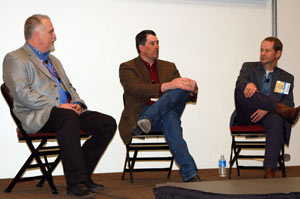
| Panelists (from left) Mike John, Bob Harrell and Leslie Callahan answered producers questions about how to create value for your cattle. |
Panel participants included Mike John, a Missouri producer and past president of the National Cattlemen’s Beef Association (NCBA). John’s operation includes a commercial cow-calf herd and calf-growing enterprise, as well as retained ownership cattle.
Also included was Bob Harrell Jr., who manages his family’s California ranch, with commercial and registered cow herds and a feedlot. Harrell also serves on the management team for Country Natural Beef (CNB), a rancher-owned beef-marketing cooperative.
Rounding out the panel was Texan Leslie Callahan, who operates a feeder cattle order-buying and trading company.
Larry Corah, a staffer for Certified Angus Beef LLC (CAB), served as moderator.
In response to a question asking what specific information contributes to added value, Harrell said it depends on the producer’s target market. However, in most markets, Harrell said, basic information would include genetic background and health protocol, plus age and source verification.
John explained that age verification is a requirement for any marketing program that serves export markets. It requires a birth date for each calf, or at least the birth date of the oldest calf in a group, with third-party verification. Harrell added that meeting this requirement qualifies cattle for up to a $25-per head premium in some programs. In his experience, Callahan said, volume matters. Buyers may want large numbers of cattle that meet specific requirements for age and other criteria, which may challenge smaller producers.
All panelists cited the importance of a documented health history. John said all calves qualifying for the MFA program are subject to a vaccination protocol and must be weaned 45 days, at home, and fed according to a standardized nutrition program. Callahan said he will not bid on cattle that have not received preconditioning vaccinations.
The panelists favored testing all herds for cattle persistently infected with bovine viral diarrhea (PI BVD). Harrell and John called it almost mandatory for seedstock operations and advisable for commercial operations.
“Some feedyards want PI-tested calves and yearlings, but they’re not always willing to pay extra for them,” Callahan said. “I think it will become an even bigger issue in the future. I’d like to see everyone do it, and then handle calves testing positive so they don’t go into someone else’s herd.”
The panelists also agreed that “natural” programs hold much potential for continued growth. John cited the lack of standardized protocols among current programs but predicted improvement in time.
“Right or wrong, some people have the perception that [growth] hormones are bad and antibiotics are bad. So we give them what they want,” Harrell said. “It costs more to feed cattle [without implants or antibiotics], so the beef has to sell at a higher price to consumers.”
All three producers agreed on the important role genetics play in adding value to cattle. Proven genetics can enhance marketing of calves marketed at weaning or any time afterward, but not all of the added value is captured unless the producer retains ownership all the way to harvest.
— by Troy Smith
Editor’s Note: This article was written under contract or by staff of Angus Productions Inc. (API), which claims copyright to this material. It may not be published or distributed without the express permission of Angus Productions Inc. (API). To request reprint permission and guidelines, contact Shauna Rose Hermel, editor, at (816) 383-5270 or shermel@angusjournal.com.